
Trading
A structured approach to the markets
How YoungTrader KD reads price: market structure, liquidity and Smart Money Concepts, applied with defined risk and reviewed through a trading journal.
Risk warning. Trading foreign exchange and gold on margin carries a high level of risk and may not be suitable for everyone. You can lose more than you invest. Content on this site is educational analysis only. It is not investment advice, a recommendation or a trade signal. Use only brokers licensed by the Capital Markets Authority (CMA) of Kenya, and consult a licensed financial adviser before making investment decisions. Read the full disclaimer.
Philosophy
Six principles
Market structure
Reading the sequence of highs and lows to define trend, range and the points where structure changes.
Liquidity
Identifying where resting orders are likely to cluster, such as above swing highs and below swing lows, and how price interacts with those areas.
Price delivery concepts
Using the Smart Money Concepts model of how price moves between liquidity and areas of imbalance, as a framework for organising observations rather than as proof of what large participants are doing.
Technical confluence
Requiring several independent factors to align before a scenario is considered valid.
Risk management
Defining risk before every decision and keeping any single loss small relative to capital.
Execution discipline
Following the plan, waiting for conditions to be met and recording every decision for review.
Methodology
Smart Money Concepts, defined
Each concept describes a pattern in price. None of them predicts the future on its own, which is why confluence and risk management come first.
Break of Structure (BOS)
Price breaks a prior swing high in an uptrend, or a prior swing low in a downtrend, in the direction of the existing trend. It is read as confirmation that the current structure is continuing.
Change of Character (CHoCH)
The first break against the prevailing structure, for example a break below the most recent higher low in an uptrend. It is treated as an early warning that the trend may be shifting, not as confirmation.
Fair Value Gap (FVG)
A three-candle sequence in which the wicks of the first and third candles do not overlap, leaving an imbalance. Price often returns to these areas, although it does not always do so.
Order Block
The last opposing candle before a strong move that breaks structure. It marks a zone of interest where price may react if it returns.
Liquidity
Clusters of stop-loss and pending orders, typically above equal or swing highs and below equal or swing lows. Price frequently moves to these areas before reversing or continuing.
Premium and Discount
A dealing range divided at its 50% level (equilibrium). Prices above it are premium and below it are discount. Buying interest is studied in discount and selling interest in premium, in line with the higher-timeframe bias.
How it is applied
From context to execution
- H4 sets the context: trend, structure and the main liquidity areas.
- M15 refines the picture: structure shifts, imbalances and zones of interest inside the H4 context.
- Sessions: analysis and execution are organised around the London and New York sessions.
- Instruments: XAUUSD (gold) and AUDUSD.
- Confluence: a scenario is only considered when several factors align with the higher-timeframe bias.

The journal
Process over outcome
Every trade idea is recorded before and after it plays out: the plan, the bias, the reasoning, how the position was managed and the result. Each entry is scored on three measures:
- Bias: was the directional read supported by structure?
- Patience: did the entry wait for the planned conditions?
- Precision: was risk defined and the plan followed?
A weekly review turns the scores into lessons and process improvements. Journaling keeps intentions and execution aligned.
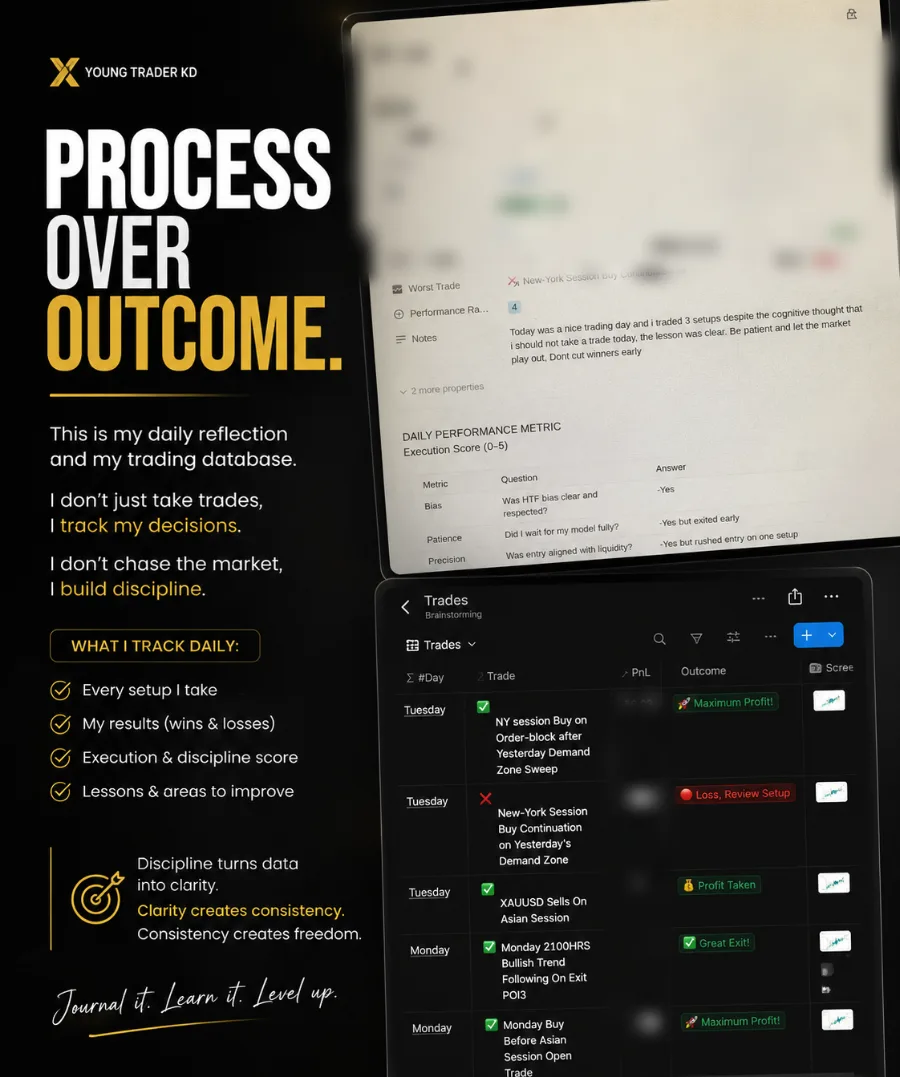
Journal record shown as a record of process, not a guarantee of results. Account details are obscured.
Risk management
What every trader should understand

Leverage
Leverage multiplies both gains and losses. A small move against a leveraged position can wipe out an account.
Position sizing
Risking a small, fixed share of capital per trade keeps any single loss survivable.
Drawdown
Losing streaks are normal. The deeper the drawdown, the larger the gain needed just to recover.
Broker disclosures required by financial regulators consistently show that most retail accounts trading leveraged products lose money.
Trading psychology
Understanding yourself as a trader
Review mistakes
Losses and errors are recorded and reviewed, not ignored.
Recognise patterns
The journal exposes behavioural patterns such as impatience, revenge trading or hesitation.
Build consistency
Discipline is treated as a skill developed through deliberate practice.
What you will find here
- Education on market structure, liquidity and risk
- Analysis notes and the reasoning behind them
- An honest journal of process and mistakes
What you will not find here
- Trade signals or entry, stop-loss and take-profit levels
- Managed accounts, copy trading or account management
- Profit promises or income claims
Before opening any trading account, confirm the broker appears on the Capital Markets Authority of Kenya list of licensed online forex brokers at cma.or.ke, and consult a licensed financial adviser.
Stay updated
Join the updates list
Receive new market analysis, journal lessons and insights. No signals, no spam.
Get in touch
Questions about the method or the journal?
Reach Paul Ngugi directly. No individual trading advice, signals or account management is provided.
Or email info@youngtrader.co.ke · Telegram